Guides
Best Apparel ERP Software in 2026: The Complete Guide for Fashion, Footwear & Home Goods Brands
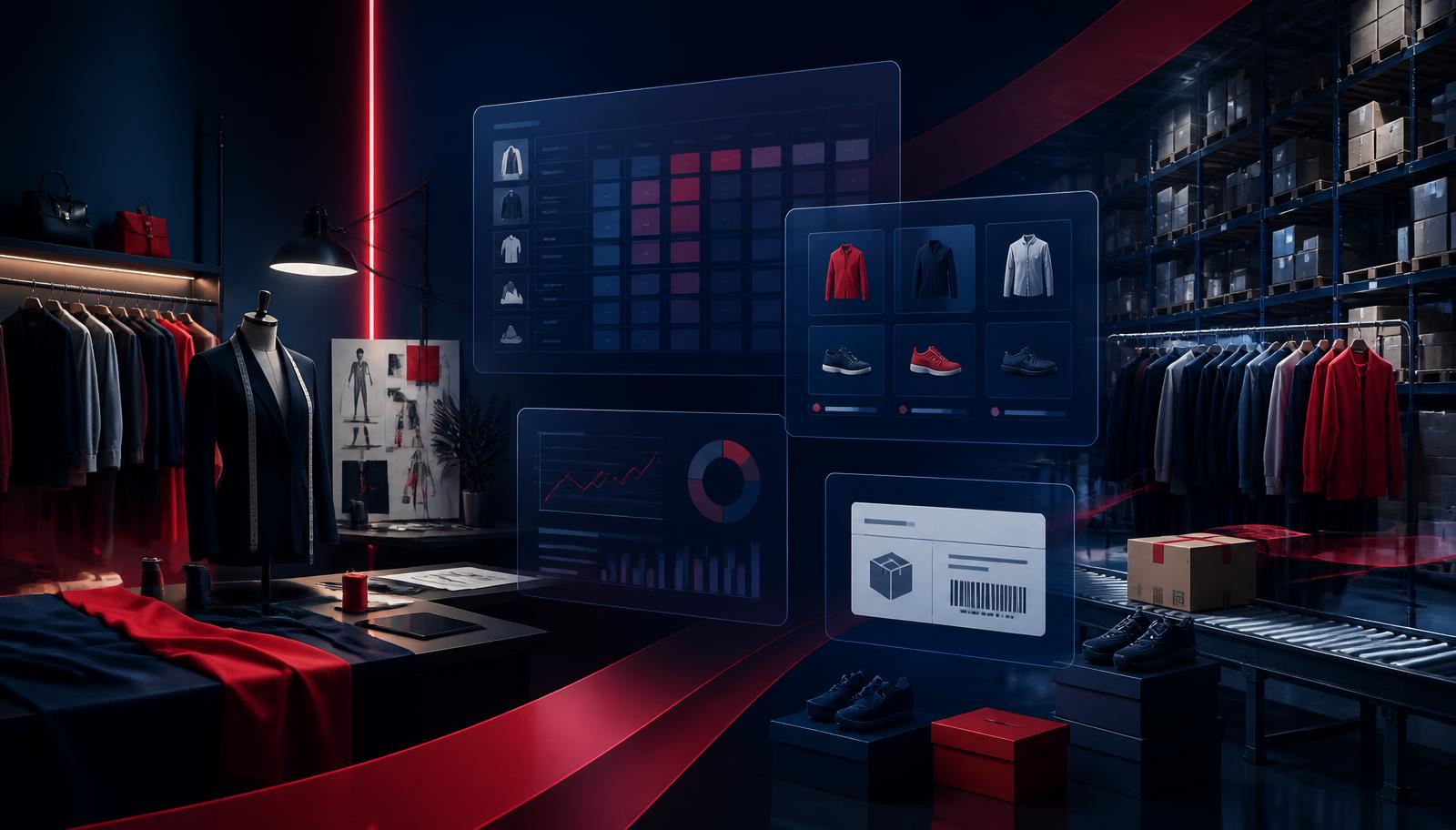
What is apparel ERP software?
Apparel ERP software is an enterprise resource planning system purpose-built for the unique operational demands of fashion, footwear, and home goods brands. Unlike generic ERP platforms, apparel ERP handles the industry-specific complexities that generic systems force you to customize around: style-color-size matrices, seasonal collections, PLM and sample tracking, EDI compliance with major retailers, landed cost calculation, and omnichannel order management.
Generic ERP platforms like SAP or Microsoft Dynamics can technically support apparel operations, but they require extensive and expensive customization to handle what purpose-built apparel ERPs do out of the box. For brands managing multiple seasonal collections, wholesale EDI relationships, and multi-channel inventory, a purpose-built system typically delivers a faster return on investment and lower total cost of ownership.
Key distinction: An apparel ERP is not just inventory software. It connects your product lifecycle (design, sampling, costing, production) to your commercial operations (orders, EDI, warehouse, financials) in a single system. The integration between these two sides is where most brands lose time and money.
What to look for in an apparel ERP
Evaluating an apparel ERP is different from evaluating a generic business system. These are the capabilities that matter most for fashion, footwear, and home goods operations:
1. Style-color-size matrix management
Every SKU in apparel exists across multiple dimensions: style, color, and size. Your ERP must handle this matrix natively — not as a workaround using product variants or custom fields. This affects everything from purchasing and production to inventory allocation and EDI transactions. Platforms that bolt this on top of a generic item model cause problems at scale.
2. Native EDI with major retailers
If you sell wholesale to retailers like Nordstrom, Macy's, Target, or Saks, EDI compliance is non-negotiable. The critical question is not whether the ERP supports EDI — virtually all of them do. The question is whether EDI is native (built into the platform, no additional fees, no third-party middleware) and whether the vendor's implementation team understands retailer-specific routing guides deeply enough to keep you compliant.
3. PLM and sample tracking
Product Lifecycle Management connects the design and development process to production and purchasing. A strong apparel PLM tracks techpacks, samples, costing, approval workflows, and supplier communications in the same system as your orders and inventory. Brands that manage PLM in spreadsheets and ERP separately lose weeks per season to reconciliation.
4. Seasonal and collection planning
Apparel operates on seasonal cycles with hard deadlines. Your ERP should support collection planning, style activation by season, carryover management, and clearance pricing without requiring manual workarounds each season.
5. Multi-channel order management
Most brands today sell through wholesale, direct-to-consumer ecommerce, and retail simultaneously. Your ERP needs to manage inventory across all three channels without overselling, and it needs to route fulfillment based on priority rules, location, and available-to-promise logic.
6. Warehouse management
Purpose-built apparel warehouse management handles the specifics of fashion fulfillment: pick-pack-ship by style and size, carton labeling to retailer spec, GS1-128 compliance, and receiving by purchase order with discrepancy tracking. A generic WMS requires configuration to handle these; a native apparel WMS handles them by default.
Native EDI vs. bolt-on EDI: the chargeback problem
EDI compliance is the most financially consequential technical decision a wholesale apparel brand makes. The difference between native EDI and bolt-on EDI is not just a feature comparison — it is the difference between staying compliant and absorbing thousands of dollars in retail chargebacks every month.
What causes EDI chargebacks?
Major retailers test EDI compliance rigorously in the first 90 days of a new vendor relationship. Common chargeback triggers include:
- Malformed or late ASNs (Advance Ship Notices)
- Carton labels that do not match retailer GS1-128 specifications
- Routing guide violations (wrong carrier, wrong ship window, wrong packing method)
- Invoice discrepancies vs. purchase order
- Late or missing 850 purchase order acknowledgments
A single malformed ASN to Macy's or Nordstrom can generate a $500 chargeback. Routing guide violations compound quickly. Brands that are "technically connected" via bolt-on EDI middleware often discover they have been accumulating chargebacks for months before the deductions show up on settlement statements.
The real cost: Brands switching from bolt-on EDI to a native apparel ERP frequently find that the chargeback reduction alone covers the cost of the new system. The connection was never the problem — the compliance detail behind it was.
What native EDI actually means
True native EDI means EDI transactions are generated, mapped, and transmitted directly from within the ERP, using the same data that drives orders, shipments, and invoices — with no middleware, no separate EDI login, no per-transaction fees, and no lag between the ERP and the EDI layer. When a shipment is confirmed in the warehouse, the ASN goes out automatically, with the right label format, at the right time, to the right retailer portal.
Ai2000 (formerly A2000 Software) has built native EDI directly into its platform for over 30 years. Implementation includes retailer-by-retailer compliance mapping, not just technical connectivity, so brands complete the first-90-day retailer compliance window without chargeback exposure.
How the top apparel ERPs compare in 2026
The apparel ERP market splits into two tiers: purpose-built specialists and horizontal platforms adapted for apparel. Here is how the leading options compare across the capabilities that matter most to fashion, footwear, and home goods brands.
| Platform | Native EDI | Native PLM | Size-Color Matrix | Native WMS | Best For |
|---|---|---|---|---|---|
| Ai2000 Specialist | Yes | Yes | Yes | Yes | Apparel, footwear & home goods, SMB to enterprise |
| AIMS360 Specialist | Yes | Partial | Yes | Partial | Wholesale fashion, SMB |
| CGS BlueCherry Specialist | Yes | Yes | Yes | Yes | Large brands, global supply chain |
| Aptean Apparel ERP Specialist | Yes | Yes | Yes | Partial | Mid-size to large manufacturers |
| Infor CloudSuite Fashion Specialist | Yes | Yes | Yes | Yes | Enterprise, global multi-entity |
| NetSuite Horizontal | Via add-on | No | Via config | Via add-on | Multi-industry, finance-heavy operations |
| Acumatica Horizontal | Via add-on | No | Via config | Via add-on | Home goods, distribution, mid-market |
Partial = capability exists but requires configuration, add-on modules, or third-party integration. Specialist = purpose-built for apparel/fashion. Horizontal = general ERP adapted for apparel.
What is the best ERP for footwear brands?
Footwear ERP has requirements that differ from apparel in meaningful ways. The size matrix for footwear includes width grids in addition to size runs, last management affects production planning in ways that apparel PLM does not address, and the supply chain for footwear is more heavily Asia-sourced, which affects landed cost calculation and import compliance.
When evaluating an ERP for footwear, the questions to ask are:
- Does the platform handle half-sizes and width grids natively, or does it require custom configuration?
- Can it manage last and component-level BOMs for product development?
- Does it handle duty drawback and HTS code tracking for imported goods?
- How does it manage size run purchasing across multiple factories and countries?
- Can it handle consignment inventory from overseas factories alongside domestic stock?
Ai2000 (formerly A2000 Software) has served footwear brands for over 30 years, with native support for width grids, size run purchasing, last management, and the retailer EDI requirements specific to major footwear accounts. Customers include brands across dress, athletic, and casual footwear categories.
Footwear-specific note: Footwear brands selling to department stores face some of the most demanding EDI routing guides in wholesale. Shoe size/width grids create more line-level complexity per PO than apparel, which increases the cost of a single EDI error. Native EDI with footwear-specific ASN mapping is not optional for brands doing significant wholesale volume.
What is the best ERP for home goods brands?
Home goods ERP requirements overlap significantly with apparel but have distinct differences: higher average unit weights affect shipping logic, product variants often include finish and material options rather than size-color matrices, seasonal demand curves are different from fashion, and many home goods brands operate both B2B wholesale and direct-to-consumer ecommerce simultaneously.
Key ERP requirements for home goods brands include:
- Multi-channel inventory management across wholesale, DTC ecommerce, and retail
- SKU variant management for finish, material, size, and pack configuration
- Landed cost calculation with container-level allocation
- Warehouse management handling bulky items, fragile goods, and pick-pack-ship for ecommerce
- B2B portal or EDI for wholesale accounts alongside DTC storefront integration
- Replenishment planning with seasonal demand adjustment
Ai2000 (formerly A2000 Software) serves home goods and housewares brands including tableware, linens, and hard goods categories. The platform handles the product variant complexity, multi-warehouse fulfillment, and wholesale EDI requirements that home goods brands face when scaling across channels.
SMB vs. enterprise apparel ERP: which tier is right for you?
The apparel ERP market serves companies from $5M in revenue to over $1B, and the right system depends as much on your operational complexity as your revenue size. Here is how to think about the decision:
Signs you need a purpose-built specialist ERP
- You have five or more wholesale EDI accounts with major retailers
- You manage multiple seasonal collections with carryover SKUs
- You source production from overseas factories with complex landed cost
- You are running PLM in spreadsheets and losing weeks per season to reconciliation
- You are experiencing EDI chargebacks you cannot explain or resolve quickly
- Your team spends significant time manually bridging order management and warehouse operations
Signs a horizontal ERP may be sufficient
- You sell primarily DTC with minimal or no wholesale EDI
- Your product line is simple (few SKUs, limited variant complexity)
- Your primary need is financial management and basic inventory tracking
- You have a large internal IT team comfortable with heavy configuration
Total cost of ownership: Horizontal ERPs appear less expensive at initial licensing but require significant implementation investment to handle apparel-specific workflows. A purpose-built apparel ERP typically has a higher sticker price but a lower total cost over five years when you account for customization, ongoing support, and the operational errors that accumulate from forcing a generic system to handle industry-specific requirements.
Why fashion brands choose Ai2000 (formerly A2000 Software)
Ai2000 (formerly A2000 Software) is a purpose-built ERP for apparel, footwear, and home goods brands, with over 30 years of industry-specific development. The platform is built around the operational reality of brands that manage design-to-delivery complexity across multiple channels, multiple factories, and multiple retail EDI relationships.
What sets Ai2000 apart
- AI-driven workflows across the entire platform, not bolted-on AI features. Demand forecasting, inventory optimization, and production scheduling are powered by AI integrated into the core system.
- Native EDI with 30+ years of retailer-specific compliance expertise. Ai2000 has mapped EDI requirements for Nordstrom, Macy's, Saks, Target, TJX, Walmart, and dozens of other major accounts. Implementation includes routing guide compliance, not just technical connectivity.
- PLM through financials in one system. From techpack to invoice, every step of the product and order lifecycle lives in the same platform. No integration maintenance, no data lag between systems.
- Built for the way apparel brands actually work. Seasonal collection management, style-color-size matrices, landed cost by container, B2B ecommerce portal, and native warehouse management are all core — not add-ons.
- One-on-one implementation. Ai2000 works directly with each customer's team to configure the platform around their specific workflows, retailer relationships, and operational requirements.
Brands that have trusted Ai2000 include Michael Kors, Carolina Herrera, Oscar de la Renta, Tumi, BCBGMAXAZRIA, Anne Klein, Free Country, and Huk.
Frequently asked questions about apparel ERP
What is the difference between apparel ERP and a general ERP? A general ERP handles financial management, purchasing, and basic inventory for businesses across all industries. An apparel ERP includes all of that plus the industry-specific capabilities that fashion and footwear brands require: style-color-size matrices, PLM, seasonal collection management, native EDI with retail EDI compliance, and warehouse management configured for fashion fulfillment. General ERPs can be configured to approximate these capabilities, but the customization cost and ongoing maintenance are substantially higher than deploying a purpose-built system.
How does native EDI prevent chargebacks? Native EDI generates and transmits EDI transactions directly from the ERP using the same data that drives shipments, invoices, and purchase orders. Because there is no middleware or separate EDI layer, transactions are accurate, timely, and formatted to retailer specification automatically. Bolt-on EDI requires manual mapping between the ERP and the EDI layer, which creates lag, data discrepancies, and compliance gaps that generate chargebacks. The most common chargeback causes — late ASNs, malformed carton labels, routing guide violations — are largely eliminated when EDI is native and the vendor has retailer-specific compliance expertise built into the implementation.
What is the best apparel ERP for small to mid-sized fashion brands? For small to mid-sized fashion brands, the best apparel ERP is one that handles the full design-to-delivery workflow natively without requiring expensive customization. Ai2000 (formerly A2000 Software) is purpose-built for this market, offering PLM, orders, EDI, warehouse, and financials in a single platform. AIMS360 is another specialist option focused on wholesale. For brands with minimal EDI requirements and simpler product lines, horizontal platforms like NetSuite can work but require substantial configuration. The right choice depends on your EDI complexity, seasonal collection volume, and sourcing model.
Does Ai2000 support footwear brands as well as apparel? Yes. Ai2000 (formerly A2000 Software) has served footwear brands for over 30 years. The platform handles footwear-specific requirements natively: width grids, size run purchasing across multiple factories, last management, HTS code tracking for imported goods, and EDI compliance with major footwear retail accounts. Footwear EDI has higher per-PO complexity than apparel due to size and width grid line-level detail, which makes native EDI with footwear-specific mapping especially important.
How does Ai2000 compare to AIMS360? Both Ai2000 and AIMS360 are purpose-built for the fashion industry with native EDI. The key differences: Ai2000 covers apparel, footwear, and home goods with native PLM, warehouse management, and financials all in one platform, and has over 30 years of retailer-specific EDI compliance expertise. AIMS360 is strong for wholesale fashion with native EDI but has a narrower footprint in PLM and WMS. Ai2000 also serves footwear and home goods categories that AIMS360 does not focus on. For brands that need the full design-to-delivery workflow across multiple product categories, Ai2000 is typically the broader choice.
How does Ai2000 compare to BlueCherry? CGS BlueCherry is a strong enterprise-tier apparel ERP, well regarded for large brands with global supply chains. Ai2000 (formerly A2000 Software) serves a similar range of capabilities — PLM, EDI, WMS, financials — but is designed to work one-on-one with each customer's team, making it a strong fit for brands that want hands-on implementation and ongoing support rather than a large enterprise deployment model. Ai2000 also extends natively to footwear and home goods, which BlueCherry does not focus on as explicitly.
How long does it take to implement an apparel ERP? Apparel ERP implementation timelines vary significantly by scope. A focused implementation covering orders, EDI, and warehouse typically runs 3 to 6 months. A full implementation including PLM, financials, and multi-warehouse management ranges from 6 to 12 months. The most common delay in apparel ERP implementations is EDI retailer mapping — getting each retail account's specific routing guide requirements fully configured and tested before go-live. Vendors with deep, pre-built retailer compliance libraries (like Ai2000) complete this phase faster than those that map requirements from scratch.
What AI capabilities does Ai2000 include? Ai2000 integrates AI across the platform, including demand forecasting, inventory optimization, production scheduling, and workflow automation. The AI is embedded in core workflows rather than offered as a separate module — so forecasting informs purchasing automatically, and inventory optimization adjusts replenishment recommendations based on current sell-through data. Ai2000 also integrates with major AI platforms including Gemini, OpenAI, and Claude at the platform level.
Ready to see Ai2000 in action?
Schedule an Operational Efficiency Audit and see exactly where your current ERP is costing you time, money, and chargebacks. Schedule Your Audit →
See Your ERP Fit